Remember Magazines?
They are alive and well at The City Reader.

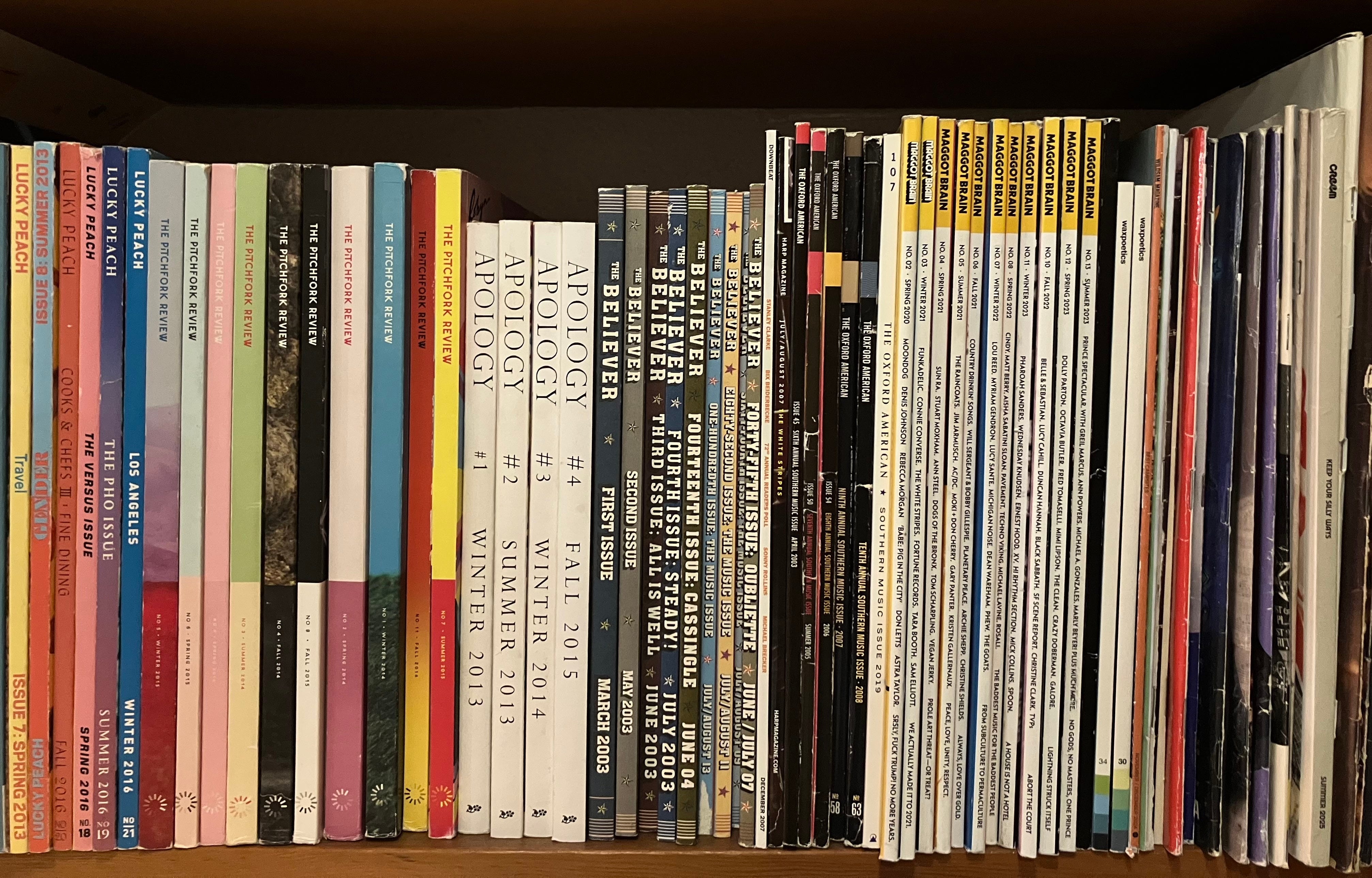
One chilly Friday at noon, Karin Dibling performed the ritual she performs every time she opens her magazine stand. She slid the front boards off her kiosk, stored them beside her desk, and lowered the front counter. After decorating the counter with large broadside issues of The New York Review of Architecture, The Whitney Review of New Writing, and Bookforum, she bookended those with a new arrival she wanted to highlight: the glossy third issue of Mildew: The Secondhand Fashion Magazine. Cover price: $20.
The City Reader is Portland, Oregon’s only magazine stand, and it’s one of the few left in the country. Specializing in niche, small circulation, and unusual titles, this kiosk offers proof that magazines aren’t dead, they’ve just reinvented themselves. Since 2013, The City Reader has operated inside a revitalized apartment building on busy Division Street, sheltered in a corridor between an organic frozen yogurt shop and a taco joint.
Karin’s first customer arrived so quickly that she didn’t have time to put the store’s sign on the sidewalk. It leaned against her desk, where the green chalk read:
A Modern Newsstand
The Best in Indie Mags
Try Something New
Her first customer wasn’t a customer. He was a friend.
Matthew ran Babs Newsstand, a small kiosk in a corridor like this in San Diego. “Zines · Mags · Books · News,” his sign says. On his biannual trips to visit family in Portland, Matthew always visited Karin, too. “She’s my mentor,” he said. After its legacy business model collapsed, magazines have become such a niche market that you have to have guidance, and Karin has enjoyed enough of what qualifies as success in this business of thin margins that she can pass the do’s and don’ts to anyone passionate, and foolish, enough to try it themselves.
There in the corridor, they talked business. What titles sold well? Who delivered which British magazines at the best speed and price? She showed him a mag she loved. “I think I sold one copy of that,” he said, scratching the back of his head.
When she recommended another, he flipped through it. “You like it?
“I do,” she said. “It’s unique. It’s experimental. It’s far from the usual.” He reached for a mag on the top furthest shelf. “That I just got in,” she said. He studied Asterisk’s yellowish cover. Issue 8’s theme was communities. “It’s a social sciences journal—smart essays about culture, science, well-researched, bold.”
Matthew ran his hand across it: “And beautiful!”
From the waist down, Matthew resembled any other middle-aged cyclist with a weatherized backpack and black, Dad-rock sneakers. From the waist up, his glasses and collared button up gave him the look of an adjunct professor, with a handkerchief tied around his neck like an ascot. But when he spoke, Matthew spoke with the unapologetic nerdiness of a true devotee. Textured covers, tasteful fonts—how smart layouts should sell more copies than they do. He fucking loved magazines. Babs Newsstand had only been operating for three months, and by taking cues from Karin, Matthew planned to make it last.
Babs Newsstand operated inside a 45,000 square-foot, multi-arts space called Bread & Salt, which itself was experimenting with a unique mixture of events, local business, gallery space, and an artist residency. “It’s in a Latino neighborhood,” Matthew said. “I am the gentrifier.” Bab’s Newsstand grew from the BAB & Friends Gift Shop, which is some kind of community-minded activist risograph publisher and distributor of zines, books, and self-described alternative comics, in a multi-use, DIY arts space that also functions as a community event space and zine library, and that may involve cassette tapes. To sell magazines now, it helped to tap into an existing community—or build your own.
Since the internet era began in 2000, print magazines have suffered declining readership, losses in advertising, and shrinking sales at brick-and-mortar stores. Legacy titles closed or went digital. Redundancies merged. Others, like Elle, Vogue, and Vanity Fair, reduced the frequency of publication to reduce their losses. The market shrank. There were too many titles that were too broad, too generic, or too similar, and people who read online didn’t necessarily buy print editions. Social media and the pandemic further changed consumer behavior and cut deeper profits. Entertainment Weekly, Marie Claire, Rolling Stone, Seventeen, RealSimple, Country Living, Details, Spin—one by one, the titles of the era shrank or shuttered. By 2022, the publishing giant Condé Nast no longer presented itself as a magazine company. It was trying to find its footing as something else.
These weren’t just US problems. In the UK in 2018, the venerable music magazine NME ceased its print edition after 66 years of production. Glamour, England’s 10th most popular print magazine, quit printing its monthly edition in 2018, too. According to The Guardian’s website, not its print edition, Ireland and the UK saw the sales of their top 100 magazines drop by half since 2000.
The print mags that Karin sells print smaller runs. They have smaller circulations. They aren’t sold in as many places. Some barely have a digital presence at all. Many qualify as luxury items. The key to successful magazine publishing now is to have a niche or a corporate backer—some media company or brand to fun production. Specialty magazines with a clear focus are thriving. Niches attract readers and allow advertisers to more precisely reach their target customers. In 2024, once popular magazine brands like Vice, Sports Illustrated, and Nylon have even relaunched their shuttered print editions, trying to find their niche in this new market. You’ll have to shop elsewhere to find those. Karin specializes in surprises.
From his backpack, Matthew pulled a small magazine he’d brought for her. She flipped through his gift while he flipped through The Gentlewoman, the self-described “fabulous woman’s magazine.”
Digesting the insights she freely gave, he shared his own experiences. He liked to hand-sell the Chicago-based magazine of ideas called The Point, but what was the cheapest way to source it? How had he missed that Wax Poetics relaunched their print issue? Did the once-popular Kinfolk have a strong sales rep to get it into stores or something, making sales pitches like “Hey, you sell neckties? You need this magazine!”
Think about what people want and what they want to be, Karin told him. “Who are they?”
He agreed. “Like, I aspire to be the kind of person who reads The Paris Review, but I’m not.”
It was just so hard separating what you liked to read from what customers might buy. But, as a curator of a kiosk, maybe those were the same things?
Forty minutes after opening, her first customer appeared and beelined for the rack. Wearing jeans with ragged cut hems, the young woman’s gloved hands flipped through the British design magazine Disegno ($20) then switched to a huge, British interior design and travel semiannual named Cabana ($40), whose top page edges were cut in a diagonal pattern, like a roof.
After letting the customer spend 10 seconds flipping through Cabana backwards, Karin sprinkled on some subtle encouragement: “That’s a great magazine.”
The customer smirked. “I’ve seen it here a couple times,” she said.
“Super fancy, a cool coffee table book size.”
“Yes. Full of inspiration.” She’d recently downsized her house, she explained, and wanted ideas about redecorating and rethinking her space.
With a mixture of detachment and precision, Karin laid a copy of Sloft in front of her—a French interior design magazine that focused on compact spaces. “See what you think of this,” she said before retreating.
The customer explored Sloft then switched to Dissent—a lefty intellectual journal of ideas and politics. When she stepped to the tiny rolling cube that functioned as the register, Karin said, “You found something good, huh?”
“I did!” Two magazines: the venerable graphic design magazine Eye, and Sloft. Total cost: $60.
The woman declined a bag for her purchase. “I will carry them proudly,” she said and stepped back outside.
Matthew hovered on the sidelines during the customer’s 12-minute visit. He seemed to listen to his mentor serve her magical blend of attention, enthusiasm, and distance, though maybe he was just reading.
Karin’s approach is to deliver a quick hit of personalized salesmanship with a lot of I’ll leave you alone now. She dips in and out, directing and validating without pressuring. It’s a skill. She knows reading is a solitary endeavor, and no magazine stand customers want an overbearing salesperson up in their biz. Instead, she gets to know her customers, their tastes, their desires.
Personal recommendations are what Karin calls her “the secret sauce.” They were, arguably, the core economic engine in bookselling itself.
In bookstores, this is called “hand-selling.” Clerks show customers a book they love or what to recommend, and that personal, enthusiastic transaction can make the sale right there. Enthusiasm drives this. Matching the product to the customer’s requests plays in, too. Also, handing someone something makes them feel indebted. It’s partly why stores provide free samples: Many customers feel the urge to reciprocate for the gift, however small, so they buy something, even something they may have felt lukewarm about, like a 60-dollar candle or a plastic clip that keeps teabag strings from falling into your mug.
But no one who comes to a magazine stand feels lukewarm about magazines. Print mags have become so niche you don’t stumble on them. You crave them, fetishize them, and seek them out. Most people visit The City Reader with great intentionality but little target other than to surprise themselves.
“I would say more than half of my customers don’t come for any specific thing,” Karin said. “They just want to see what’s new, what’s cool, see what I’m interested in right now. A lot of people will ask me what my favorite magazine is. ‘Show me which is the best magazine on your shelf’ is what they’re asking me, as opposed to what I think is a great magazine.”
Wearing orangish pants, a black and white flannel, and bobbed hair, the 57-year-old owner often stands with her hands folded atop each other, thoughtful, but relaxed. You could imagine her as a librarian, if she didn’t laugh so much. When she says ‘yeah,’ you hear her native Chicago, and her yeahs often come in twos. If one of her mags were profiling her, it might say that she had the bright vibrant eyes of someone deeply engaged with social and intellectual life. Because she specializes in unusual titles, shoppers don’t recognize most of what they see on her shelves, so her hand-selling works at the intersection of their interests and her recommendations.
“When people come to the newsstand without a specific magazine in mind, they’re looking for a feeling,” she said. “Like, they want something cozy. They want something to make them think today. They want something to entertain them, or that will expand their interests in whatever topics they find interesting. So I give them a half dozen things, and in one, two, three of those things, they see whatever they’re looking for. It’s a gut reaction, because it’s not like they can actually read a ton of what they find. I mean, sure, they can sit and stay as long as they want and read as much of it as they want! But they’re still following their feelings.”
And people feel smothered by screens.
“Because everything is screen-based now, people want to separate from that in their downtime,” she said. Unlike the way computers and phones make people feel, customers respond positively to the physical nature of a magazine. “I don’t know about you, but I don’t want to read a tablet. I want to read a print object.”
Second, the magazine format offers a unique experience.
“The beginning and end of a magazine make it appealing,” Karin said. “Like, it’s finite. It’s curated. Somebody picked what’s between the covers of a magazine. They thought it was important enough to put in there, so it’s not just endless scrolling, where it can be any crap that you’re lookin’ at. It’s something somebody thought was good.”
Unlike the endless scroll, you can lose yourself in a magazine temporarily, but it’s not a bottomless pit that squanders your valuable time. Having a tangible end makes a magazine something you can wrap your head around. It’s comprehensible. It rewards readers for their effort, instead of making you feel weak and adrift and powerless to resist. “I, personally, think finishing a magazine gives you a sense of satisfaction.” She shrugged. “That’s how I feel about it.” Do people look up from 30 minutes of vacant scrolling and go Ahh, that felt good?
You can get lost online. You can’t see all that’s out there. With no edges to guide you, navigating it can feel like wandering in the darkness while blindfolded. What will you bump into? You may arrive with a goal but wander off, getting sidetracked and lonely. Magazines give you page numbers, articles to move between, a back page you feel coming. And here in the corridor, people buzz by and carne asada scents the air. The smell, the sound, the feeling of being out in the world instead of scrolling on your couch—that becomes part of The City Reader experience. Shopping is tactile. It’s comprehensible, just like Karin’s objects.
Small-circulation magazines often have high production values. Heavy card stock, matted covers, dazzling colors—the sensory experience of a printed object appeals to people. You feel it. You smell it. Your brain engages with physical words and images differently than those on a screen. That’s biology. Humans have spent so little of our evolutionary history engaging with screens that, as helpful as technology is, our brains are so accustomed to print media that they consume that stuff and file it differently than digital information. “I carry beautiful things!” Karin said it with a laugh, but she was proud.
And no matter how beautiful, magazines demand little of you. Bound paper requires no electricity. You only need to open their pages to use them. Of course, there was nothing simple about producing a magazine, but print media’s simple user interface offers a refreshing opportunity to decompress from our overwhelmingly complicated world.
Her friend had more questions: Did most customers pay with cards, cash, or apps? How did she use her spreadsheets? Distributors, discounts, returns, sales, titles of interest—“It’s a lot of details to keep track of,” she said. With shifting inventory, staying profitable required organization and planning. “Spreadsheets are my external hard drive.”
He didn’t look like a spreadsheet guy.
Curating her inventory required reading people as much as it required reading to source new titles. “I’m always judging the mood of the moment,” she said, “what’s going on with people and the culture right now. When Covid was going on, people wanted interior design magazines, because they were at home so much. As soon as Covid started going way, people got interested in travel magazines, and food. People are always interested in food magazines.” She carried lots of those, like Toothache (created by chefs for food enthusiasts), Linseed Journal (“themed around a single ingredient with enduring cultural significance”), and Nobel Rot (wine). But right now, days after President Trump’s reelection, nobody wants to read Jacobin or anything remotely political. “So that stuff’s going away, and I’m going to fill some of that space with something else.”
The kiosk’s lowest shelf contained an incredible variety of kids’ magazines: Ranger Rick, Highlights, Anorak, and Kazoo. Above that, familiar mainstream titles like Dwell and Harvard Business Review stood by a whole magazine dedicated to an interview with a single person (Mono Kultur), a quarterly devoted to slow journalism (Delayed Gratification), and a whole zine for goths (Dark Entries). There was also Mother Tongue (a biannual about modern motherhood), Tools (a French annual that examines a single manufacturing technique in each issue), Konfekt (“The magazine for Sharp Dressing, Drinking, Dining, Travel and Design”), Brownbook (“An Urban Guide to the Middle East), We Jazz (about jazz), Solo (about coffee), Butt (a biannual about queer culture and sexuality), MOLD (“Designing the future of food”), Eaten (“the food history magazine”), Tonic (“A heady cocktail of drink, travel and adventure”), Slightly Foxed (“The real reader’s quarterly”), Lodestars Anthology, Field & Station, Pleasant Place, The Common, The MacGuffin, The Baffler, The Drift, The Beautiful Truth, Kitchen Table, A Rabbit’s Foot, Idler, Maggot Brain, Paperboy, Noema, Openhouse, Flaneur, Rebel Roots, Feels, Violet Book, Upper Case, and Luncheon. And Summit Journal, Surfer’s Journal, and Bicycle Quarterly.
“This is the new normal for magazines,” said Karin. “The beautiful things, as opposed to the disposable, conventional ones.” Like The Economist: It comes and goes in a week. But a 30-dollar magazine? “That’s going to sit on your coffee table for a while!”
At 1:08, a customer came in for the new Paris Review. She didn’t come to browse. She didn’t come to chat. She paid for her literary magazine and left.
Karin and Matthew shrugged. Some just sell themselves.
* * *
Karin’s relationship with magazines started when her mother gave her an issue of Cricket when she was little. Growing up in Chicago, her grandpa ran a print shop downtown, making the paper cards, stationary, catalogues, and event invitations that were popular at the time. Karin spent a lot of time in his print shop: first just running around during school breaks, later, “working” there as a teenager. In the summer, they rode the train in from the suburbs with their grandmother. Those summer rides felt nice in her memory. The large print ship machines made noises and smelled a particular way—like oiled metal. So did her grandfather’s crisp printed products. “I’m sure my love of print has to do with that,” she said. “It has to. Print is in my blood.”
Chicago used to have a lot of bookstores, and Karin made her living selling books in them. When she moved to Portland in 1999, the first thing she did was apply for a job at Powell’s Books. At the time, Powell’s was the largest new and used bookstore in the country. Back when Portland was a quieter bohemian city, it let you live on less money, so Powell’s drew all sorts of artists, aspiring writers, and bibliophiles who wanted interesting but less demanding work that paid enough to survive. Of course, Powell’s saw her resume and hired her. Unfortunately, she only landed a job in Powell’s contact center in a warehouse. Instead of ordering books as a purchaser, instead of spending her days in a store’s overstuffed aisles, putting books in peoples’ hands, she sat on the phone, taking customer’s orders. “I hated it.”
Around 2009, magazines started to experience a renaissance. Digitization, and America’s great recession, changed many businesses, including publishing. As mainstream commercial print publications like Esquire and Rolling Stone suffered declining readership and shrinking mastheads, independently published magazines started emerging in their place.
“Desktop publishing let people do it all themselves,” said Karin, “and a lot of small operations, these independent, rebel-type people, looked around and said, ‘I’m going to start a magazine!’” Some of those people were laid off editors and burned-out designers. Others preferred offline entertainment to screens, or wanted to slow down as life sped up. Although some were attached to design agencies and nonprofits, these were publications owned by big corporations like Conde Nast. Many qualified as independent publications, even DIY or “alternative” publications. Together, they formed what The City Reader website calls a “new and vibrant scene.”
Over the years, Karin’s phone job burned her out, but by working in books, she noticed the magazine renaissance.
For how arty and DIY Portland was, few people in Portland seemed to notice the indie magazine renaissance, though. Most of America seemed to have missed it, too. In fact, as commercial magazines in the United States declined, they thrived in the rest of the world. Japan had thousands of magazines. “They’re all in Japanese,” Karin said, “and they don’t export them, but there are plenty!” Paris and Barcelona still had newsstands. There were magazine kiosks in London and all over Europe. A few small newsstands still operated in New York City—including Soho News International, which enjoys a cult following. Maybe some exist in a few other large U.S. cities, too, but mostly, they’d gone the way of the mall and the Barnes and Noble bookstore chain. America was missing out. There in the contact center, Karin’s mind kept returning to the magazine renaissance. “Portland didn’t need another bookstore,” she decided. “It needed magazines. And I’m like, ‘What the heck. Midlife crisis. Let’s do it!’”
To keep overhead low, she wanted a kiosk, not a store. “As my first business, I wasn’t going to do some big thing. It was just me. I didn’t want employees.” She searched the city for a space small enough to accommodate a kiosk. When she told property owners her business venture, many got confused: You want a what? “Finally the guy who owns this building thought it was a great idea.” He’d just remodeled the building and created this common area.
So in 2013, she started The City Reader and filled Portland’s—and America’s—market gap. She trusted that Portland had enough people who still loved magazines. Gradually, she found them. They ordered from all over the country. The shrinking local marketplace also put a finer point on her offerings.
Powell’s Books’ flagship downtown location still sold magazines, but they’d moved their shrunken selection from massive racks near their busy Green Room entrance to a hallway where customers often lined up for the register. Rich’s Cigar Shop downtown used to have the city’s largest and best magazine selection. Tons of customers tolerated that gross smoke to browse. After the pandemic, Rich’s liquated their inventory and never replenished. Their buyer didn’t think young people cared about magazines anymore. They were too much trouble. Attrition made Karin the only game in town, but skill and enthusiasm made her the best. What she found was that it wasn’t true no one cared about magazines. It’s that the people who do care, care deeply. “Some people forgot about how much they loved magazines,” Karin said, “and they’ve rediscovered that here. Some never knew how great magazines could be until they found the kiosk.”
* * *
After Matthew left, Karin straightened titles, pulled stock from one of the bottom cabinets, and the sound of Fleetwood Mac’s “Dreams” filled the corridor.
She put on her glasses and studied a spreadsheet on her laptop. She arranged five new magazines and photographed them for Instagram.
One woman sat at one of the eight nearby tables, drinking a pint of beer and reading a magazine she’d purchased here. Behind her, two folks did what looked like schoolwork on laptops.
Karin’s set up was simple: kiosk, a rolling cubicle for her workspace, one laptop, one tall chair. A single black plastic chair wedged itself between the kiosk and the front window, providing a place to read while facing the sunlight street. Above it a sign: “Shop Local.” As a devoted black tea drinker, she kept an electric kettle on her desk with an electric mug-warmer. On her feet, thick-soled house slippers kept her comfortable with warm wool uppers. Her profit margins aren’t big, but she filled enough of a niche to survive for a decade and counting. “It’s a lifestyle choice,” she told one reporter, “let’s put it that way.” Her motto: “Keep overhead low, and keep things moving.”
“It takes a little while—it took me a little while—to figure out the flow: How much stuff I could buy, and when. When to reorder things and not to reorder things. How many copies I should get. And it takes a while to figure out what your clientele wants. Then things change. For a while something will fly off the shelves, then interest will wane and some new cool thing will arrive, so you buy less of that first thing. Stuff like that. It takes experience.”
Even with experience, purchasing is tricky. If a title is popular, you don’t want to miss sales by ordering too few copies. “But on the other hand,” she said, “when the new issue comes out, you don’t want a stack of the old issue sitting around, so it’s better to sell them all than to have too many.” That’s another motto.
As clear as her categories of magazines were, she didn’t have a motto for how she organized her shelves. “There is a logic to it,” she said, “but I couldn’t say what it is. It’s just a feeling. Some of it comes down to space. When I add something to the design section, I have to pull something off that shelf, because those magazines are big. I just feel it out. There’s an art to it, but I also definitely think that moving things around helps people see different things. If everything’s in the same spot every time, then they’re not necessarily going to pay attention to something that’s been hiding behind something else for a long time. But if I move it around, new things are lookin’ at’cha!”
Her third customer arrived at 1:33 and immediately grabbed a copy of Eye.
Karin said, “Let me know if I can help.”
He didn’t look up. “Just browsing, thanks.”
This 30-something with brown pants, clean green sneakers, and a receding hairline flipped through “the international review of graphic design” at a casual pace, head tilted, mouth agape. A rolled-up copy of The Portland Mercury alt-weekly poked out of his back pocket. When he returned Eye to the shelf, he worked his way to the right and grabbed Wildsam, a new publication that had recently made the risky financial decision to transform from a series of pocket-sized indie travel guides to a traditional-looking glossy “dedicated to road trips, recreational vehicles and the outdoors.” What drew this customer to it? What made him put it back?
“Well,” said Karin, “that’s the tactile part. Watchin’ it, feelin’ it, smellin’ it.”
He flipped through Trails (“The only magazine for backpackers.”), then Surfer’s Journal (no), then Current Affairs (also a no).
“Doin’ alright?” Karin said.
He was. He marveled at the section.
“We just got this,” she said and set the new issue of Asterisk in front of him.
He thumbed through and returned it.
At 1:47 he bought Sight and Sound, the British Film Institute’s monthly magazine, and Karin slipped it into a satisfyingly crisp paper bag. Total cost: $11.
She estimates that three-quarters of her customers are regulars. “Not every week, or even every month customers, but absolutely regular customers.” As if on cue, the front door opened, and a man in a bright orange running jacket and shorts walked in. “Like this guy,” Karin said with a laugh.
Confused about suddenly being the focus on attention, the man said “Hello, I am a loyal customer” in a comical robot voice.
He’d come for his copy of the English runners quarterly Like the Wind, which he described as “the best running magazine in the world.” She special orders it for him then IG messages when it arrives.
His name was Mike Russell. A 54-year-old cartoonist and creator of The Sabertooth Vampire and CulturePulp comics, he’d majored in magazine journalism, back when more universities offered that course of study. He’d also worked in publishing in the 1990s: first as managing editor at Portland Living, a struggling startup that ran out of money, then as the editor of two community papers—one which no longer exists—then he reviewed movies and books, and drew a comic strip, for The Oregonian from 2004 to 2014. It was unclear how he earned his living now, but he still loved longform journalism. “I collected Spy magazine in the ’90s—I have all but six issues of it,” he said. “That was my great love affair with journalism, the classic magazines of yesteryear: Spy, Rolling Stone, and Esquire with the George Lois covers and all that stuff. So I’m a real huge fan of what she does.”
As an editor, he’d noticed the kiosk when he’d run past the building. When he finally stopped to ask if she had any running magazines, she presented Like the Wind. He’s never seen it anywhere else.
“She is singlehandedly keeping the craft of making magazines, and the art of reading magazines alive,” he said, “from the front of the book to the back. That’s a special way to consume information, and there’s not a lot of that going on now. She finds all the people who are trying to do that well.”
Karin smiled as he showered her with praise.
She could mail his purchases to him, but a quarterly ensured him four in-person visits a year. He liked seeing all the colorful covers on the shelves. He liked chatting with Karin. In our digital era, where you can get anything delivered and survive for weeks without leaving your house, magazines provide information as much as a sense of community, and community just feels good.
“It brings me back to a very nostalgic time in my life,” Mike said, “in my 20s, when I would go wander through bookstores and browse the magazines.”
He still thought like an editor, too. When he went to buy shoes at a local running store, he overheard someone talking about Like the Wind. It turned out to be Simon and Julie Freeman, co-founders of his favorite running quarterly. They were touring American running stores to build their U.S. audience, so he introduced himself and pitched them a freelance story in-person. The story was an oral history of the 1980s running movie, On the Edge. “Which nobody remembers,” he added. During the pandemic, his hobby became tracking down everybody who was in that movie to write an oral history about it. “I talked to actor Bruce Dern for three and a half hours. I talked with Pam Grier, who actually got cut from the theatrical release, though she was added back in on the VHS. Everybody was like, ‘Why do you want to talk about this movie?’”
It was a compelling pitch, though he and the running magazine hadn’t yet signed a contract. “We’ll see,” Mike said. “I don’t know if it will get in there.”
Karin waved as he walked back outside holding his magazine. “People like him are the reason I do it.”
Author’s note: I wrote this story in 2022. Since no magazine wanted to publish it, I give it to you, dear reader. I don’t know, I kinda thought it was interesting, but maybe I’m wrong?
As I like to say, it’s not nostalgia, it’s history.
This lovely piece gets at something phones and feeds have trained us to forget: a magazine has a beginning, a middle, and an end. It is a finite performance for the fingers, the eyeballs, and the mind. Paper, ink—the smells!— sequence, pacing, texture, surprise. No endless scroll.
I’m writing along parallel lines at A Photographic Memory, here on Substack, about the heyday of print, when magazines ruled the media and a ringing telephone could send a photographer, like me, almost anywhere, into a green room, a campaign scrum, a movie studio, a disaster zone, even the White House. The camera is my vantage point, not my readership category.
If you’ve got a niche, scratch it. Maybe some of these new specialty magazines will write new history.
I lived in Portland for a decade and thrived in its slightly avant-garde, slightly weird vibe. Still miss it! Also, I’m a recovering magazine junkie… those glossy pages, that special smell, the surprise revelation in a feature piece. I could blather on.